Who makes the official determination?
The state or its authorized contractor. AirCheck collects and transmits authenticated data; it does not unilaterally determine compliance.
Digital infrastructure for state emissions programs
AirCheck Auto gives state vehicle-emissions programs a secure at-home testing channel — adding capacity, reducing motorist friction, and preserving official program authority.
Our mission 1000000000 miles
A billion miles never driven to an emissions station. Testing exists to keep states clean and compliant. Taking the trip out of the test serves both — fewer tailpipe miles, higher compliance rates, and better data for the programs that set the standards.
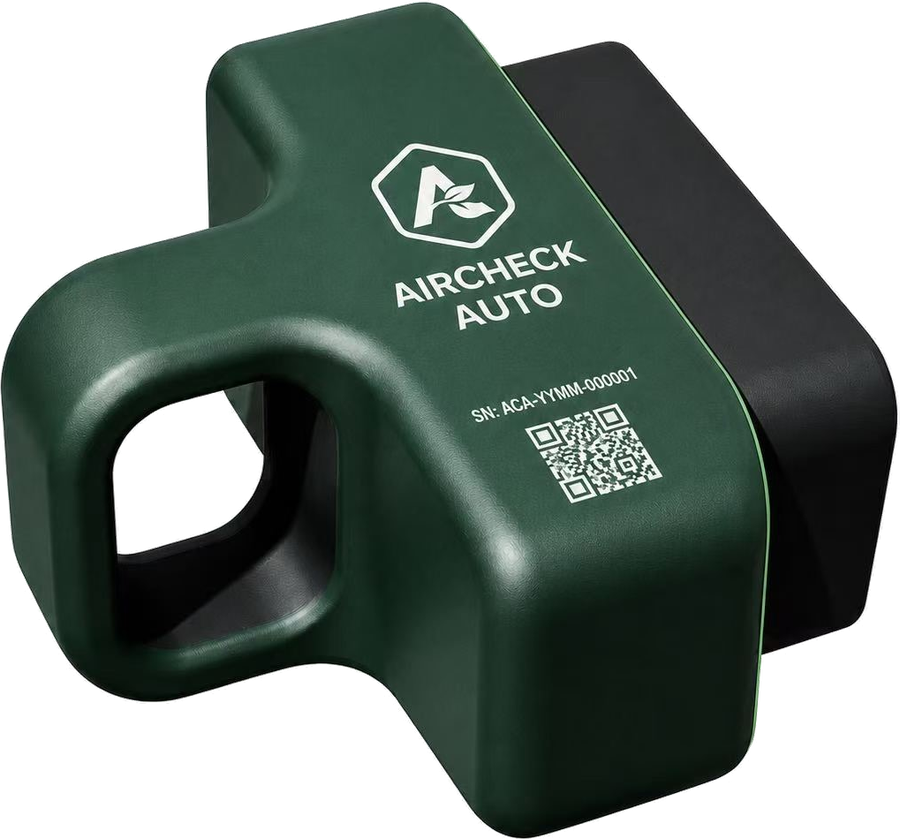
Serialized hardware, bound to one vehicle
A billion miles never driven to a test Expand motorist access Add capacity without adding stations Preserve environmental integrity Modernize the compliance journey
Part 01The program opportunity
Many modern inspections are fundamentally electronic OBD transactions, yet the delivery system remains tied to fixed locations. That creates avoidable access, capacity, labor, and real-estate pressure.
AirCheck extends the existing program — it does not replace the state, the official database, or the physical inspection network.
Part 02Public value
Reach motorists with distance, mobility, schedule, and caregiving constraints through an approved at-home option.
Absorb eligible OBD volume without building, leasing, or staffing additional lanes and stations.
Reduce friction before registration renewal while preserving eligibility, audit, and enforcement rules.
Deliver a measurable digital-government improvement that motorists can see and use.
Part 03A controlled path to approval
A narrow, evidence-led pilot lets program operations, legal, IT, cybersecurity, registration, and incumbent partners validate the channel together.
Phase 01
Run matched AirCheck and station sessions without affecting official compliance records. Measure result correlation, VIN accuracy, completion, and exception rates.
Phase 02
Tightly gate supported vehicles. The authorized program applies official logic; every exception returns to the existing station network.
Phase 03
Scale only after technical equivalence, fraud controls, support burden, device return, and program economics meet agreed thresholds.
Part 04Environmental integrity by design
AirCheck is regulated testing infrastructure, not a retail code reader. The platform is designed to produce an immutable, reviewable data package while keeping official eligibility and compliance determination with the state or its authorized prime.
Part 05Fits the existing ecosystem
Retains standards, approval, audit, enforcement, and environmental oversight.
Controls eligibility, renewal integration, identity records, and compliance clearance.
Can retain official submission control and participate economically in every remote transaction.
Receives exceptions, failures, physical confirmations, and repair referrals.
Part 06Operating model
Control — State or prime
The state or prime identifies an eligible vehicle and approved test method.
Control — AirCheck Auto
Serialized hardware is bound to one vehicle, consumer, and test cycle.
Control — Bound device
Guided connection produces a regulator-grade OBD and identity data package.
Control — Authorized backend
The authorized backend applies program rules and updates compliance records.
Next stepStart with a narrow, measurable pilot
AirCheck Auto is engaging state environmental and motor-vehicle agencies, prime contractors, and inspection-network partners to design controlled remote-OBD validation programs.
We’ll respond with a proposed working-session agenda and pilot-readiness checklist.
FAQProgram questions
The state or its authorized contractor. AirCheck collects and transmits authenticated data; it does not unilaterally determine compliance.
The model is designed to preserve official submission control, create transaction economics for the prime, and route exceptions back to the physical network.
Initial pilots should tightly gate standard, supported OBD-II passenger vehicles and exclude any vehicle requiring unsupported tailpipe, opacity, safety, or physical elements.
Serialized device binding, ECU and physical VIN checks, plate verification, location and telemetry controls, encrypted transmission, risk scoring, and random confirmation testing.
No. The recommended sequence begins with non-official shadow validation, then advances to a bounded official pass-only pilot under explicit program oversight.
Programs can set gates for official-result agreement, VIN accuracy, completion, support burden, device return, fraud loss, access impact, and transaction economics.